
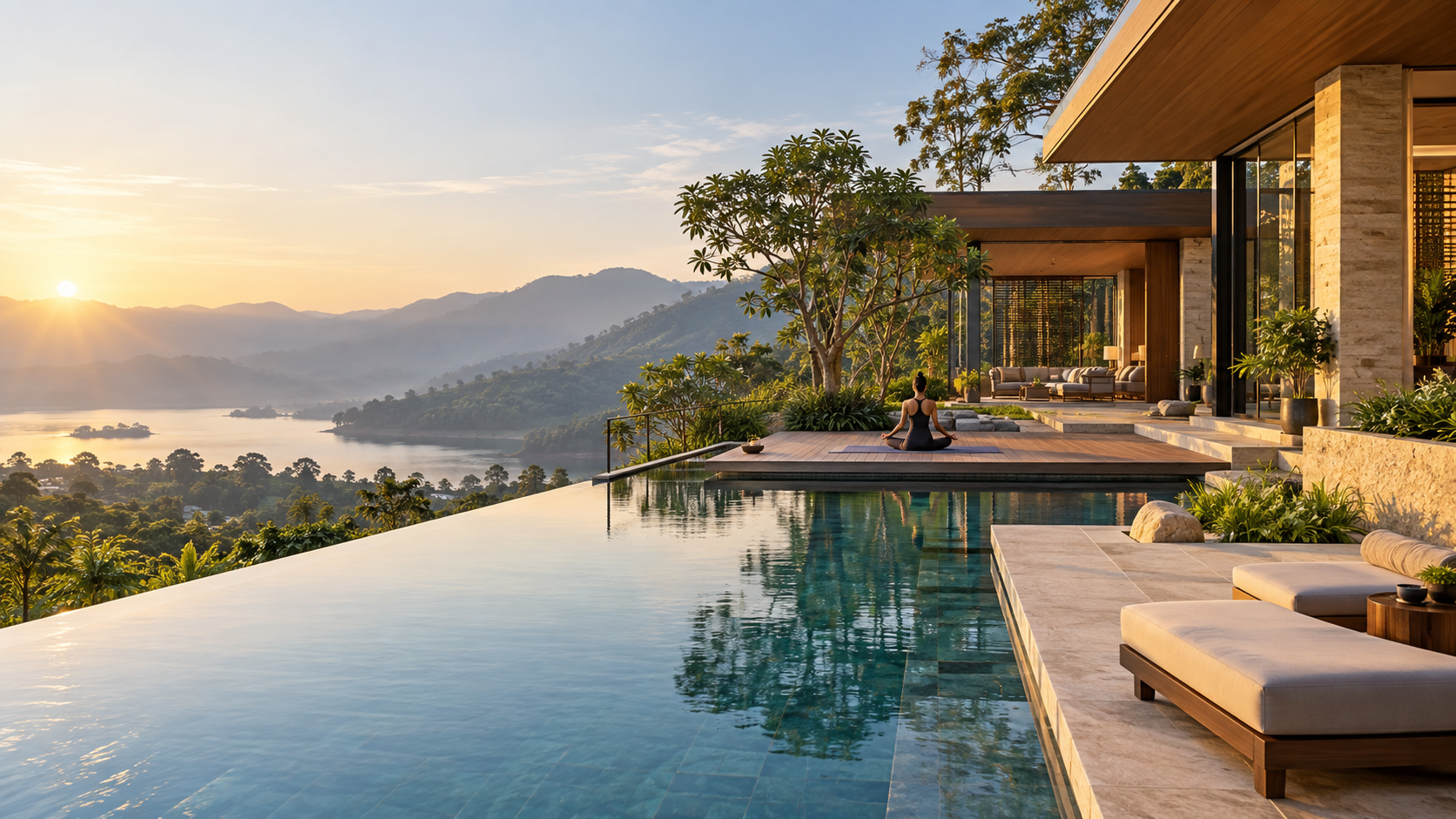
Wellness is no longer a hotel amenity. It is becoming an investment thesis.
Across India, travellers are spending more on experiences linked to health, recovery, nature, mindfulness, nutrition and preventive wellbeing. At the same time, institutional investors and hospitality companies are increasingly looking at differentiated leisure, experiential and wellness-led assets.
For hotel owners and developers, the opportunity is clear: wellness hospitality has the potential to become one of the most compelling growth segments in India’s next hospitality cycle.
The demand is already visible
The global wellness economy reached approximately US$6.8 trillion in 2024 and is projected to approach US$9.8 trillion by 2029, according to the Global Wellness Institute.
India has emerged as a significant market within this growth story. Its wellness economy was estimated at approximately US$180 billion in 2024, making India the seventh-largest wellness economy globally, with growth of around 11.3% annually between 2019 and 2024.
The more important indicator for hospitality investors is traveller spending.
Wellness tourism accounted for approximately 8.3% of global tourism trips in 2024 but generated 17.6% of tourism expenditure.
That difference matters.
It indicates a traveller who is potentially willing to spend more, stay longer and pay for experiences beyond the room.
For hotel investors, wellness can therefore influence not only occupancy, but also ADR, length of stay, ancillary revenue and overall asset positioning.
Capital is moving towards differentiated hospitality
Recent developments in India also point to growing interest in premium, experiential and wellness-led hospitality.
Skift’s coverage of SAMHI Hotels’ investment in RARE India highlighted the commercial potential being recognised in boutique and experiential hospitality businesses.
Accor has also reiterated its ambition to expand significantly in India while keeping partnerships and acquisitions within its growth strategy.
Perhaps more significantly for wellness hospitality, The Economic Times reported in September 2026 that Chalet Hotels was in advanced discussions to acquire Six Senses Vana in Dehradun for approximately ₹600 crore.
A single transaction does not define an industry, but it provides an important signal: premium wellness assets are increasingly entering conversations around institutional hospitality capital.
India has a natural advantage
India does not need to invent a wellness proposition.
Ayurveda, yoga, meditation, naturopathy, spirituality and traditional healing are already deeply associated with the country.
Add to this a growing domestic affluent traveller, increased awareness around preventive health, stress, sleep, nutrition and longevity, and the opportunity becomes much broader.
The winning Indian wellness resort, however, may not resemble the traditional spa retreat.
The next generation of projects could combine:
Indian healing traditions with contemporary wellness
Nature and hospitality with structured programmes
Rest and recovery with movement and nutrition
Diagnostic wellness with luxury accommodation
Spirituality with modern design and service
The opportunity lies in modernising Indian wellness without stripping it of authenticity.
Wellness is not one hotel format
This distinction is critical for investors.
A wellness resort could be built around Ayurveda and traditional healing. Another may focus on sleep, stress reduction and recovery. Others may specialise in women’s wellness, active lifestyles, longevity, nutrition or integrated preventive health.
Each requires a different operating model, investment level and target customer.
This is why simply adding a larger spa to a resort does not create a wellness asset.
The concept must answer a clear question:
What is the guest travelling here to achieve?
When that answer is specific, wellness becomes easier to programme, price and market.
The commercial opportunity goes beyond room revenue
A well-planned wellness property can create several revenue streams beyond accommodation.
Structured three-, five- or seven-night programmes can move the conversation away from room rates toward packaged experiences.
Treatments, consultations, nutrition programmes and specialist therapies can increase ancillary spend.
Destination retreats, corporate wellness programmes, memberships, curated food concepts and retail can further diversify revenue.
More importantly, a strong wellness proposition can create something increasingly valuable in hospitality:
a reason to travel specifically for the hotel.
That distinction can separate a destination asset from a hotel that simply competes with surrounding inventory.
But not every site should become a wellness resort
The sector’s growth should not encourage indiscriminate development.
Wellness hospitality requires greater concept discipline than conventional resort development.
Before committing capital, investors need to assess:
Location: Does the landscape, climate and accessibility support the experience?
Catchment: Is the property a weekend destination or a longer-stay retreat?
Customer: Who will travel, how frequently and what will they pay?
Programme: What level of medical, therapeutic or wellness expertise is commercially viable?
Scale: How many rooms should the project actually have?
Positioning: Is wellness the core reason to travel or simply one component of a broader leisure resort?
These questions should be answered before the architecture is finalised.
The Spectra perspective
At Spectra Hospitality, we believe India’s next phase of hotel investment will increasingly be driven by micro-market intelligence, differentiated concepts and experience-led asset creation.
Wellness sits directly within that shift.
The investor question is no longer:
“Should the resort have a spa?”
It is:
“Can wellness create a reason to travel, stay longer, spend more and return?”
When supported by the right location, demand base, programming and financial model, the answer can be powerful.
India already has the wellness heritage.
Consumer behaviour is evolving.
Hospitality capital is paying attention.
The real opportunity now is to identify the right land, the right market and the right wellness proposition — and convert a growing trend into a commercially resilient hospitality asset.
That is where wellness moves from amenity to investment strategy.